
OSD 359: The next vibe shift
What happens after the government co-opts the Current Thing
Years ago, the creators of South Park did an interview with Charlie Rose where they explained their show’s sensibility:
When we met, we were both [Monty Python] fans and we were both sort of punk rockers. And we wanted to do a punk rock TV show. When we were growing up, the way to be punk rock was to be really liberal, because we grew up with Reagan when we were in high school and all that.
But then the problem was, we moved to LA, and the only way to be punk rock in LA is to be a Republican.
This is why people buy new clothes instead of wearing their parents’ hand-me-downs. The clothes were cool when your parents bought them. Seriously. You would have agreed with them at the time. But then your parents bought them, rendering them uncool for a generation.
A year ago, RETVRN memes were punk rock. Vibe reels were punk rock. The modern wave of military-industrial complex companies were punk rock.
Now … they are not. What was once ascendant is subsumed by the government, for the government’s own purposes. A vibe that was once energetic and forward-looking is now gov slop, served hot daily. It’s clear they’re proud to be serving it hot, too, under the belief that the more current the meme, the smoother it goes down.
Here are two copies of the same picture:

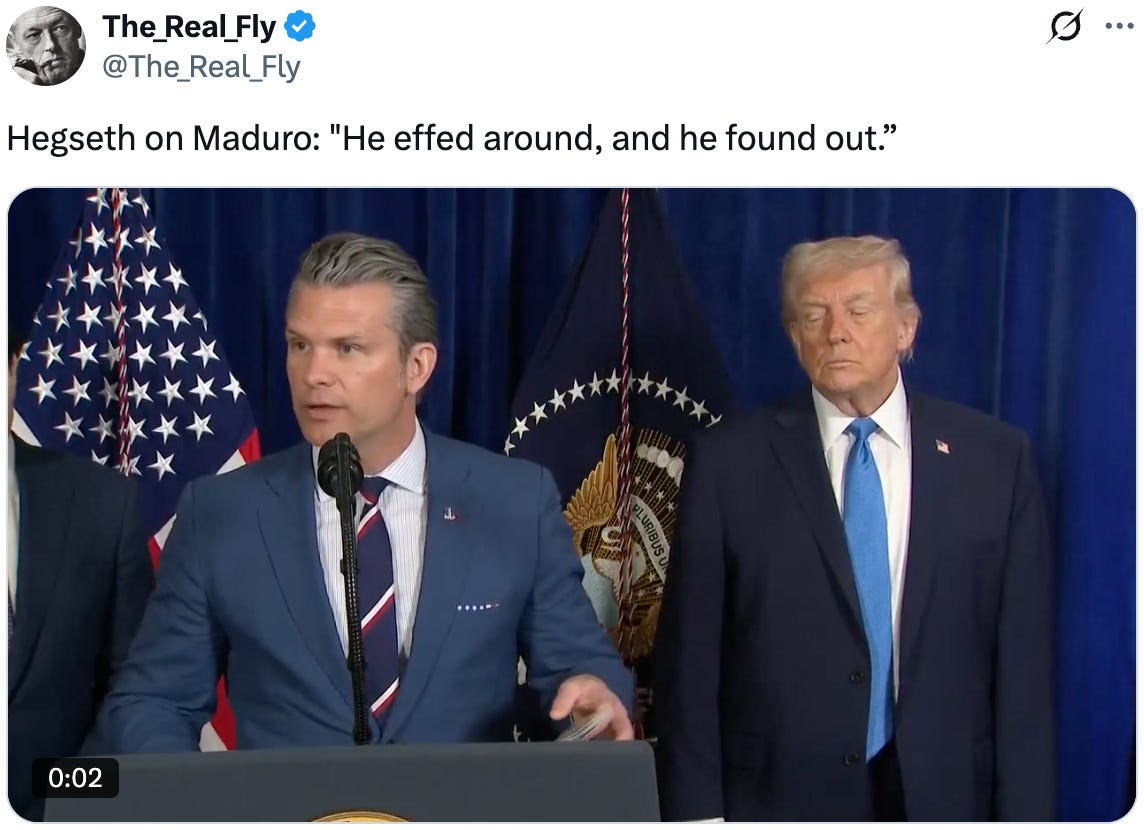
The government takes memes and marries them to state power.
For the kind of things we talk about here, this is particularly noticeable in gov tech and military tech. We’ve written about it a bunch:


Government competence tech slips towards government empowerment tech. The only thing that prevents that is making it structurally impossible. Consider this except from OSD 322:
It’s likely the solution to our problem isn’t to hope people and companies make the right decisions. That’s gravy if it happens, but as Milton Friedman said, a good system makes it so even the wrong people will do the right thing. You need a structure that boxes people into the right decisions.
What’s a structural solution to the question of when and how to equip the government? Here are a few ideas:
Distinguish between government competence tech and government empowerment tech. When you interact with the government, you definitely want them to be competent. That means using great software, having good equipment, and doing all the things you’d expect from an excellent private company. Tech that enables that is a good thing. But be wary of tech that focuses on empowering the government relative to individuals.
The government can have whatever it wants, as long as I can have it too. There is no viable near-term path to applying this to heavy military equipment, but why start with far-fetched examples? Let’s start with basics. And not just small arms, which people naturally think of first. Deregulated drones and comms are even more important.
Beware proprietary government data sets. There are some data sets relevant for the government’s internal operations that will inevitably stay private. Lists of employees, a database of the Army’s tanks, and so on. But any time the government is compiling data en masse about individuals, or claiming root access to a private company’s processes or data, that is a One Ring that someone is eventually going to try on for size.
None of those three criteria are going great. For a lot of the companies that came up on the promise of making government better at doing what it should be, the reality turns out to be making government better at doing whatever it wants.
This is new territory for people into gun rights and civilian defense. Historically, those interests have implied an antagonistic relationship with the government. That seems to have abated for now. The current federal government is taking the “how do you do, fellow kids” approach on this. Some of them are fellow kids.
But from first principles, centralized state power is hostile to civilian defense. That is as close to a law of physics as you get in government. Sometimes it’s obvious as kinetic energy — arrests, prosecutions, loss of liberties, etc. Sometimes it hides as potential energy — a state that takes no action on the in-group’s liberties, or is even friendly, but which is increasing its overall power. Sooner or later, potential energy gets released.
So in the current moment, there are two things that started out decentralized and got co-opted:
Unseriousness. This is not unique to a particular party or person. It has been accelerating for years. There is scant evidence that the most powerful recent figures in government even aspire to intelligence or constitutional principles.
Government competence → government empowerment. Government competence is the idea that when you interact with the government, it shouldn’t suck. Government empowerment is the idea that when you interact with the government, it shouldn’t end. People think totalitarianism means dictatorship, but really what it means is a totalizing state. A state involved in everything. A non-totalitarian state is one where people don’t think about the government.
The good news is that government co-opting a trend tends to kill that trend’s energy. So in the private sector, we’re going to see a return to seriousness. People dedicating themselves earnestly to valuable things, and importantly, that being valorized.
Government empowerment tech is a tougher call. It could be a cyclical trend, or it may be here to stay for a while. A privacy breach or scandal could put it in check, or a terrorist attack could completely take the brakes off.
That’s why a gun rights mindset always distrusts a powerful state. The government’s role is too powerful to be left to the government.
This week’s links
Doug Ritter from Knife Rights on The Weekly Reload Podcast
The under-discussed cousin of gun rights. Nobody has done more for knife rights in the US than Doug. His org has successfully lobbied for repeals of knife bans in 32 states and over 200 cities and towns.
Ballistic matching is pseudoscience
H/t @Chevron in our Discord. Radley Balko wrote a good piece in 2023 on this subject too.
About Open Source Defense
OSD Capital
Investing in decentralization and freedom. Reach out.
OSD podcast
In-depth interviews with outstanding founders and builders in civilian defense.
The company store
Grab a t-shirt or a sticker.
Discord server
The OSD team is there along with lots of subscribers. Become a paid Substack subscriber to join the chat.
> When we met, we were both [Monty Python] fans and we were both sort of punk rockers. And we wanted to do a punk rock TV show. When we were growing up, the way to be punk rock was to be really liberal, because we grew up with Reagan when we were in high school and all that.
> But then the problem was, we moved to LA, and the only way to be punk rock in LA is to be a Republican.
I lived in the Bay Area during the mid 2010s, and baffled at all the wokeness. I grew up in the midwest; when I moved to San Francisco, I did not personally know even one person who thought gay marriage should be _decriminalized_, nevermind _legal_, just to put things in perspective.
And so when I was in California in like, 2015, one thing that absolutely baffled me was the sharp discord between the left's rhetoric and the left's reality. Rhetorically, everything was very very "underdog". Counterculture, protest culture, fight the system, fuck the man, punching up, etc etc etc. But, realitywise, the left controlled literally every institution of power in America at that time, and, in the strongest possible terms, *could not* be called an underdog.
At the time, I observed a lot of irrationalities on that side, and I interpreted a lot of them as some weird consequences of "the source of their cultural power comes from being the underdog, but, they're not the underdog, so they have to do a whole bunch of mental gymnastics so that it doesn't all come crashing down around them"
Mark my words, in 5 years, this reasoning will apply to Republicans
The GC vs GE distinction is really insightful. It's also why I disagree with your article about police training. Among many other things, I look at misconduct records for a living - the large majority of allegations, indignities, and incidents wouldn't be fixed with training because the underlying encounter should never have happened. Traffic stops fishing for drugs - Why are the drugs even illegal? Stop and Frisk - if we got our way, carrying would be legal anyway. Same deal with warrant raids gone bad; they mostly shouldn't be happening at all. I could go on, but more training often empowers departments because it makes legal ass-covers without making them really change anything. See also, diversity trainings in the corporate world